Gold and Platinum Shares on the JSE: What the 2026 Swings Mean for Traders
If you have watched the Johannesburg Stock Exchange this year, one thing has moved the market more than anything else. Gold and platinum, and the South African companies that mine them, have jumped and dropped harder than almost anything else on the local market. Big moves plus local names make this a sector worth understanding, rather than one to chase headline by headline.
This article covers what happened, where prices are now, who the main mining companies are, and what the swings mean for how you manage risk. It is here to inform, not to advise. Nothing below is a tip to buy or sell anything.
A Year of Two Halves
The easiest way to understand 2026 so far is to see how fast this sector went from painful to rewarding.
In June, gold and platinum fell hard. Gold dropped about 12% in the month, back toward 4,000 US dollars an ounce. Platinum fell even more, down about 19%. The mining shares fell further still, because miners usually move more than the metal itself. Gold miners lost about 15% in June and platinum miners about 23%.
Then it turned around. In August, the main JSE precious metals index gained about 38%, its best month on record going back to 2006. Gold miners rose roughly 38% as gold climbed close to 10% for the month. Platinum miners rose about 21%, with platinum passing 1,900 US dollars an ounce for the first time since early June. Several of the biggest gold names gained more than 40% in that one month.
Earlier in the year showed how sharp the falls can be too. In one day in February, gold and platinum prices suddenly dropped, and JSE mining shares fell between 9% and 13% in that single session. The move was big enough to pull the whole market down and weaken the rand.
The same shares, in the same year, gave traders a record month and some of their worst days.
Where Prices Are Now
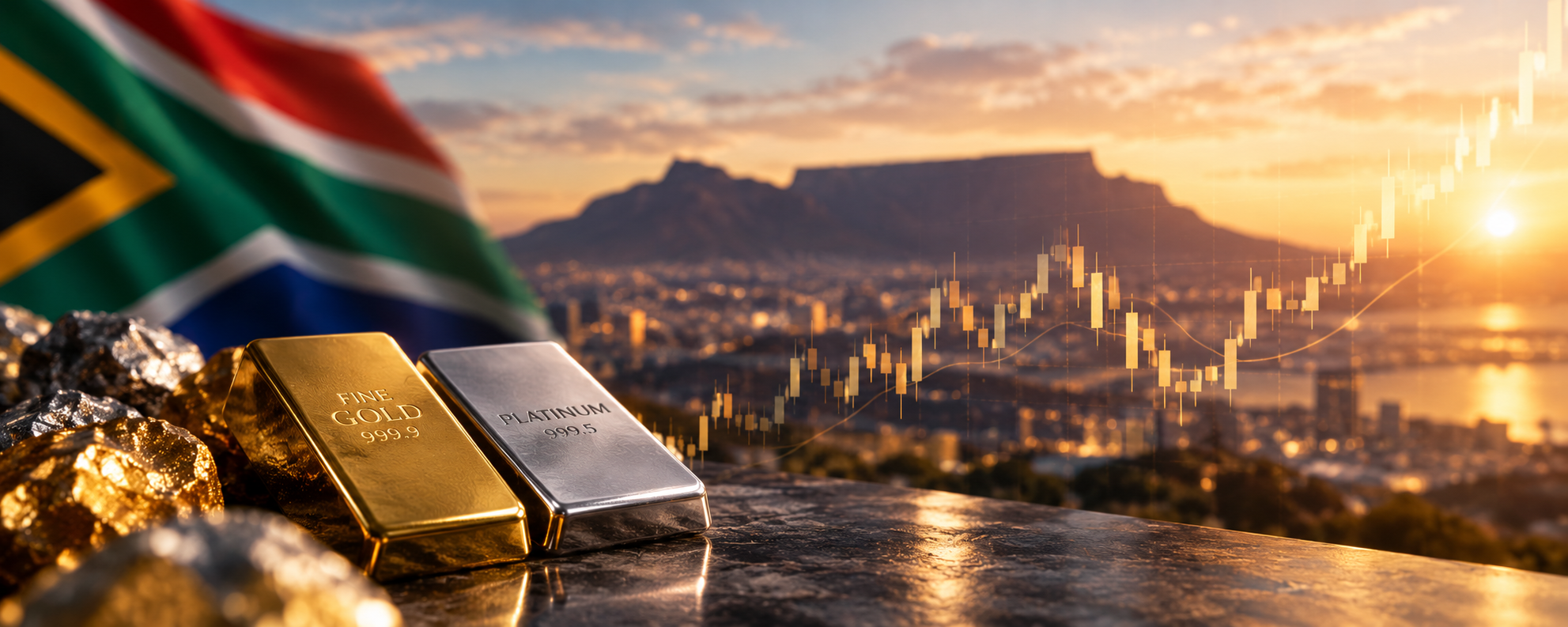
On 22 September 2026, gold was trading around 4,300 to 4,360 US dollars an ounce. It had eased over a couple of days as the US dollar firmed. That is below its record high of about 5,589 US dollars, set in late January, but still well above where gold sat a year ago.
Platinum was trading around 1,847 US dollars an ounce on the same day. That is a strong recovery from where it sat in the middle of the year, and it is the strength that lifted platinum miners through August.
Snapshot: Metals, 22 September 2026
| Metric | Level | |---|---| | Gold | ~$4,330 per ounce | | Platinum | ~$1,847 per ounce | | JSE precious metals index in August | +38% | | Gold's record high | ~$5,589 per ounce |
Gold was below its January record but remained significantly higher than a year earlier. Platinum had passed $1,900 in August before easing back.
Two things drive most of these moves. The first is the US dollar. Gold pays you no interest while you hold it, so when the dollar is strong, or interest rates look set to rise, gold tends to soften. When the dollar is weak, gold tends to rise.
A lot of August's gain came alongside a weaker dollar.
The second thing is platinum's own story. Platinum is used a lot in industry, not just held as an investment, so it moves on its own supply and demand.
The Main Mining Companies
South Africa is home to several of the world's biggest gold and platinum producers. Knowing who they are, and what they actually mine, explains why they do not all move together.
| Company | JSE | Mainly Mines | What to Know | |---|---|---|---| | AngloGold Ashanti | ANG | Gold | One of the biggest gold miners in the world, based in Johannesburg with mines in nine countries. One of the most valuable shares on the JSE. It no longer mines inside South Africa but is still listed here. | | Gold Fields | GFI | Gold | A large gold miner with operations in Africa, Australia and the Americas. One of the names that led the August jump, gaining more than 40% for the month. | | Harmony Gold | HAR | Gold | The biggest gold miner operating inside South Africa, started in 1950, with mines here and in Papua New Guinea. Chaired by Patrice Motsepe. | | Sibanye-Stillwater | SSW | Gold and Platinum | Mines both gold and platinum, so it is pulled by two different markets at once. It was among the shares that rose through August. | | Impala Platinum | IMP | Platinum | A leading platinum miner. Its shares were among the sharpest movers in both directions this year, including double-digit falls in the February drop. | | Pan African Resources | PAN | Gold | A mid-sized gold miner and one of the strongest performers in the August rally, up more than 40% for the month. | | African Rainbow Minerals | ARI | Mixed, including Platinum | A mixed miner started by Patrice Motsepe, with interests in platinum, iron, coal and copper, plus a 20% stake in Harmony Gold. |
The split between gold names and platinum names matters. Gold moves mainly on the dollar, interest rates and safe-haven buying. Platinum has that extra industrial side to it.
If you treat the whole sector as one thing, you can get caught out when gold and platinum move in opposite directions, which they often do.
Why the Shares Move More Than the Metal
A pattern kept showing up this year. The mining shares moved much more than the metals did.
When gold rose close to 10% in August, gold miners rose closer to 38%. When platinum fell 19% in June, platinum miners fell 23%. This is normal, and it is worth understanding before you trade these shares.
The reason is that a mine costs about the same to run whether the metal sells for a little more or a little less. Most of its costs are fixed.
So when the metal price rises above what it costs to dig it up, most of that extra goes straight to profit, and the share can rise by several times the metal's move.
The same works in reverse. When the metal price falls toward the cost of mining it, profit shrinks fast, and the share can drop far more than the metal.
The thing that made the August gains so big is the same thing that made the June and February falls so hard.
The Rand Angle
For South African traders there is an extra layer. Gold is a big part of what South Africa sells to the world, so a rising gold price tends to lift both the rand and the wider JSE.
When gold is strong, the rand often strengthens with it, and mining shares get that currency effect on top of the metal move.
This is why local traders watch the gold price in rands, not only in dollars. The rand price of gold captures both the metal move and the currency move in one number, and that is the number that matters when you think in rands.
One point on gold itself: Gold has had steady demand this year, including heavy buying from central banks. That demand has helped hold the price well above where it sat a year ago, even through the sharp drops. It does not remove the swings. It just sits underneath them.
What the Swings Ask of You
The lesson from this sector in 2026 is not a direction. It is discipline.
A sector that can post a 38% month and a 10% down day in the same year is one where how much you put on, and how well you control risk, matter more than any single call on where gold goes next.
A few simple points come out of the year so far:
- Trade smaller when the swings are bigger. A share that can fall 13% in a day needs a smaller position than one that moves 2%.
- Know what you are holding. A gold share and a platinum share are different trades with different drivers, even on the same exchange.
- Remember the big moves cut both ways. The same effect that drove the August gains drove the June and February losses.
- Watch the things that actually move the metals: the US dollar, US interest rates, and for platinum, demand from industry. These tell you more than any one day's headline.
Closing Notes
South African mining shares have been the story of the JSE this year, up and down. The August rally was real and record breaking. So were the June and February falls. All of it came from the same place: metals that move on global forces, and mining shares that move even more, with a currency effect on top for local traders.
The value in following this sector is not in guessing the next move. It is in understanding how it works well enough to size your trades sensibly and know what you are actually holding. A trader who gets why these shares swing is in a far better spot than one who is just chasing the last green candle.
At BOF Asset Management, our aim is to give local traders proper access to these markets, along with the knowledge to trade them with structure. Knowing what you are exposed to is the first step. The rest is discipline.
Disclaimer
BOF Asset Management (Pty) Ltd is an authorised Financial Services Provider, FSP 53819, Category 1, regulated by the Financial Sector Conduct Authority of South Africa.
This article is for general information and education only. It is not financial, investment or trading advice, and not a recommendation to buy, sell or hold any security. Company names are used only to show what has been happening in the market. Trading and investing carry a real risk of loss and may not suit everyone. Past performance does not tell you what will happen next. Prices and figures are as at the dates shown and change all the time. Get advice suited to your own situation before you act.
Sources include the FTSE/JSE Precious Metals and Mining index, JSE company disclosures, Kitco, JM Bullion and public market reporting, as at 22 to 23 September 2026.