
South Africa Just Paid the Highest Petrol Price on Record. Here Is What Is Behind It.
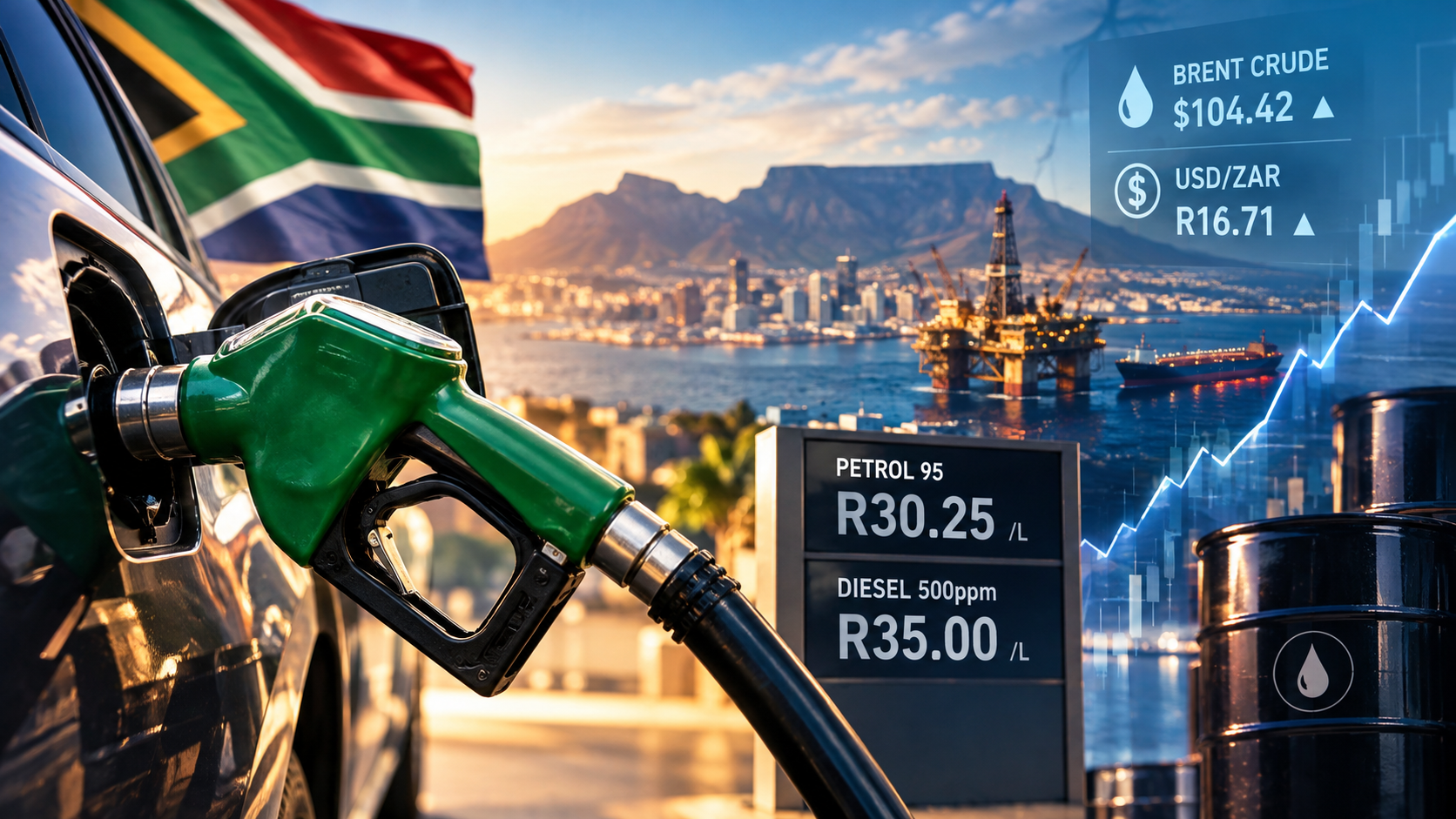
Since last Wednesday, South Africans have been filling up at prices that were unthinkable a year ago. The price of 95 unleaded petrol in Gauteng rose to R30.25 a litre on 7 October 2026, the first time in history that petrol has broken through R30. Diesel crossed R35 a litre at the retail pump.
This did not happen overnight, and it will not reverse overnight either. Understanding what caused it, and what needs to change for prices to come down, is the difference between watching events unfold and being positioned to act on them.
How South Africa's Petrol Price Is Set
South Africa does not produce meaningful quantities of crude oil, they import almost all of it, primarily from Angola, Nigeria, and Saudi Arabia, and they buy it in US dollars. Every month, the Department of Mineral and Petroleum Resources adjusts the regulated pump price based on two things: the international price of Brent crude oil, and the rand/dollar exchange rate.
When Brent goes up, prices go up. When the rand weakens against the dollar, prices go up. When both move against you at the same time, you get October 2026.
What Caused the Record Price
Disruption along the Strait of Hormuz, the critical chokepoint through which a significant portion of the world's oil supply passes, pushed the cost of imported refined fuel even higher than the crude oil benchmark itself. South Africa imports a large share of its fuel already refined, which means it was hit twice: once by the rising crude price, and again by elevated refining margins.
Brent crude climbed from $87 per barrel in late August to a high of $108 per barrel in mid-September as tensions in the Middle East escalated. The rand/dollar rate moved to R16.71 per USD during this period, compounding the pressure.
The result, confirmed by the Central Energy Fund and the Department of Mineral and Petroleum Resources:
| Fuel | Change | New price (inland) | New price (coast) | |---|---:|---:|---:| | Petrol 95 | +R3.33/litre | R30.25 | R29.38 | | Petrol 93 | +R3.12/litre | R29.88 | R29.09 | | Diesel 500ppm | +R2.84/litre | R31.95 | R31.08 | | Diesel 50ppm | +R3.24/litre | R33.23 | R32.21 |
Coastal 95 petrol has climbed from R19.92 a litre in March to R29.38 now, a rise of nearly 48% in seven months. That is close to R10 more per litre than South Africans were paying at the coast seven months ago.
The Costs That Follow Fuel
The pump price is the headline. What follows it is the real story for most South Africans.
Minibus taxis carry most South African commuters, and taxi fares have climbed throughout 2026 as diesel costs mounted. For the millions of South Africans who depend on public transport to get to work, this is a direct income hit before they have even started their day.
For businesses that move goods, the cost of logistics rises immediately. Retailers, manufacturers, bakeries, farms, and cold chain distributors all run on diesel. When diesel crosses R35 a litre at the retail pump, that cost moves into the price of groceries, building materials, and every other good that travels on a truck. Inflation does not announce itself. It arrives quietly in the weekly shopping basket.
South Africans who rely on paraffin for lighting and cooking are now paying R31.82 per litre, compared to R27.05 for the period from September to early October. That increase falls hardest on lower-income households.
The South African Reserve Bank has taken a cautious approach to the oil price shock, hiking interest rates by 25 basis points at alternate MPC meetings since May. A basis point is one hundredth of a percent. 25 basis points is a quarter of a percent increase on the repo rate, which flows through to home loans, vehicle finance, and business credit. Another 25 basis point hike is being considered for November, though it is highly dependent on how the fuel price moves.
Is There Any Relief Coming?
The honest answer is: possibly, but it is conditional.
The Central Energy Fund's latest data shows a noticeable improvement in the fuel price under-recoveries projected for November. Earlier projections were tracking a R4.70 per litre increase in petrol for November. The most recent data, updated at the end of last week, shows that figure has come down.
The improvement is linked to oil prices declining after President Donald Trump stated that the US would not attack Iran before November's mid-term elections. That statement removed some of the geopolitical risk premium that had been priced into Brent crude.
However, the November outlook based on current data still projects:
- Petrol 93: projected increase of R3.16 per litre to approximately R33.04
- Petrol 95: projected increase of R3.35 per litre to approximately R33.60
Those are projections based on data from early October. They will change, and this week's events will contribute to that change directly.
What Happens This Week Matters for November's Price
South Africa's petrol price is set monthly based on average rand and oil price performance across the review period. That means every day Brent crude trades lower, and every day the rand holds firm or strengthens, marginally improves the outlook for November.
Today, Monday 12 October, the US dollar index has eased to around 102.20 on renewed hopes of a Russia-Ukraine energy ceasefire. A weaker dollar is, in theory, mildly positive for the rand and for oil's impact on South African fuel prices.
The most significant event this week is US inflation data, the Consumer Price Index. If US inflation comes in lower than expected, markets may price in a softer Federal Reserve stance. That would weaken the dollar further and reduce pressure on the rand. Brent crude is currently trading at $104.42, with analysts forecasting a range of $99 to $108 through to Friday. If Brent drops toward $99 and the rand holds, the November fuel price outlook improves. If Brent climbs toward $108, it worsens.
The Federal Reserve also meets on 27 to 28 October for its next interest rate decision. That outcome will set the tone for the dollar, the rand, and oil heading into November's fuel price review period.
What This Means for South African CFD Traders
When Brent crude moves, South Africa feels it in a way most other countries do not. That connection creates a direct reason for local traders to follow the oil market closely.
Trading Brent crude CFDs allows you to take a position on the oil price without buying physical barrels. If you believe the geopolitical situation will worsen and oil will push higher, you can go long. If you believe the Iran risk premium will fade and oil will drop back toward $99 or below, you can go short. Both are live trades this week.
For traders who prefer currency markets, USD/ZAR is also active. A softer dollar and lower Brent crude price would be rand-positive. A stronger dollar with oil above $105 would pressure the rand. CPI data and the Fed meeting are your catalysts.
Position size and stop losses matter more than usual in a week this event-heavy. The market can move significantly in a single session when high-impact data releases and geopolitical developments land simultaneously.
The Bottom Line
South Africa is at a fuel price record that was almost unimaginable at the start of this year. The causes are global: oil above $100, a Middle East conflict that disrupted supply routes, and a rand that has been under pressure all year. The costs are local and they compound through transport, food, and borrowing costs.
Relief is possible, but it depends on oil coming off its highs and the rand recovering ground against the dollar. This week's US inflation data and this month's Fed meeting will both influence that outcome.
Watch Brent crude. Watch USD/ZAR. The petrol price is not just a number at the pump. It is a live market signal with real consequences for every South African.
Risk Disclaimer: CFD trading carries a high level of risk and is not suitable for all investors. You may lose more than your initial deposit. BOF Asset Management is authorised and regulated by the Financial Sector Conduct Authority (FSCA), FSP licence number 53819, Category 1. Please ensure you fully understand the risks before trading.